The modern corporate landscape is defined by the constant struggle between ambitious goals and finite resources. For PMO leaders and project directors, the ability to distribute human and technical capital effectively is not just a skill but a core competitive advantage. As projects grow in complexity, the traditional methods of manual oversight are becoming obsolete.
The foundation of every successful initiative begins with a firm grasp of project management basics. However, the jump from managing a single project to overseeing a global portfolio requires a more sophisticated approach. Executives are now turning to intelligent automation to ensure that their most valuable assets are never underutilized or overextended.
Resource allocation is the process of assigning and managing assets in a manner that supports an organization strategic goals. When done correctly, it minimizes waste and maximizes throughput. By integrating the Advanced Resource Allocation AI System into your management framework, you can transform a chaotic scheduling process into a precise, data-driven operation.
The Crisis of Traditional Resource Management in PMOs
Senior IT managers often face the challenge of talent scarcity combined with unrealistic timelines. In many organizations, resource planning is still handled via static spreadsheets that are out of date the moment they are saved. This lack of real-time visibility leads to bottlenecks that can paralyze even the most well-funded departments.
Inefficient allocation does more than just delay projects: it causes burnout and high turnover among top-performing employees. When people are constantly moved between high-priority tasks without a clear logic, their productivity drops significantly. Mastering project resource management is the only way to protect your team while still meeting aggressive business targets.
The shift toward a success-driven culture requires a departure from reactive management. Leaders must be able to predict resource gaps before they occur. This level of foresight is only possible when you move beyond manual calculations and embrace the power of high-level analytical prompts and blueprints.
Transitioning to an AI-First Allocation Strategy
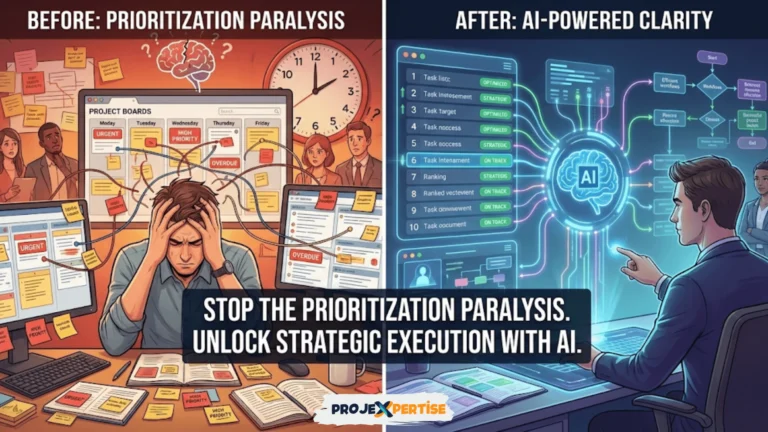
Artificial intelligence has redefined what is possible in the realm of project oversight. Instead of spending hours trying to balance a complex matrix of skills and availability, managers can now use specialized logic to find the perfect fit for every task. This transition is a key part of modern Workflow Automation which allows for seamless operations.
The use of AI does not replace the project manager: it empowers them. By delegating the repetitive task of data processing to an AI system, directors can focus on high-level decision-making and leadership. This synergy is essential for maintaining AI project manager productivity in a high-pressure environment.
Integrating these digital assets allows for a level of precision that was previously unattainable. You can now weigh factors such as individual skill proficiency, historical performance, and current task load simultaneously. This ensures that every assignment is optimized for both speed and quality.
Aligning with Professional PMBOK Standards
Every senior leader knows that professional standards provide the structure necessary for global success. The principles outlined in the PMBOK 7th edition emphasize the importance of value delivery and tailoring. AI systems are uniquely capable of adhering to these standards while providing the flexibility needed for modern projects.
Standardization ensures that everyone in the PMO is speaking the same language. When you use a standardized blueprint for resource allocation, you eliminate the subjectivity that often leads to internal conflict. This alignment is critical for achieving a high level of project delivery across the entire organization.
Furthermore, these systems support the core principles of project management by fostering a culture of accountability and stewardship. By using data to back every allocation decision, you build trust with your team and your stakeholders. You are no longer making best guesses but rather following a mathematically sound roadmap to success.
Enhancing Oversight with Intelligent Reporting
Visibility is the cornerstone of effective leadership. Without accurate data, a project director is flying blind. High-quality reporting tools are necessary to provide the insights needed to make informed adjustments in real time.
An AI-driven system integrates resource data directly into your reporting dashboards. This provides a single source of truth for the entire organization. When a resource conflict arises, it is highlighted immediately, allowing the PMO to intervene before the critical path is affected.
This level of transparency is also vital for ROI measurement. By tracking exactly how resources are utilized and comparing that to project outcomes, you can demonstrate the clear financial value of your management strategies. This data is indispensable when presenting to the board or requesting additional budget.
Maximizing Budgetary Efficiency through AI
Financial constraints are a reality for every project manager. The ability to do more with less is often what separates top-tier managers from the rest. Leveraging specialized budgeting tools in conjunction with AI allocation ensures that every dollar is spent wisely.
Resource costs typically represent the largest portion of any project budget. Misallocation is essentially a waste of capital. By optimizing the distribution of your team, you reduce the need for expensive last-minute contractors or overtime pay.
The predictive nature of AI allows for better long-term financial planning. You can simulate different resource scenarios to see how they impact the overall project cost. This allows you to select the most cost-effective path forward without sacrificing the quality of the final deliverable.
Integrating AI with Existing Tech Stacks
One of the most common concerns for IT managers is the difficulty of adopting new technology. The ProjeXpertise blueprints are designed to avoid this friction. They act as an analytical layer that enhances your current time management tools rather than requiring a total system overhaul.
Whether your team uses enterprise-grade software or simpler platforms, the AI logic can be applied to your existing data. This ensures that you can start seeing improvements in resource efficiency without a lengthy implementation period. The system is platform-agnostic, meaning it grows with your organization.
This integration is a vital part of a comprehensive project scheduling strategy. When your resource data and your schedule are synchronized via AI, the result is a dynamic plan that responds to real-world changes. This level of agility is a prerequisite for success in any complex industry.
Managing Risk through Proactive Allocation
Resource scarcity is one of the primary drivers of project risk. If a key team member is overbooked or a critical piece of equipment is unavailable, the entire timeline can collapse. Effective project risk management must include a deep analysis of resource availability.
The AI system constantly monitors for potential resource risks. It identifies single points of failure where a project is too dependent on a single individual. This allows the director to cross-train staff or reassign tasks to mitigate the threat before it becomes a crisis.
By maintaining a balanced workload across the team, you also reduce the risk of human error. A team that is not overworked is more focused and produces higher-quality work. This proactive approach to resource health is a hallmark of a mature and successful PMO.
Improving Stakeholder Confidence and Communication
Stakeholders expect clarity and reliability from project leaders. When a director can show a clear, data-driven plan for resource utilization, it instills confidence at the highest levels. This transparency is a key element of effective stakeholder engagement.
Communication is the bridge between a project technical needs and its strategic goals. By using AI to generate clear resource roadmaps, you can explain complex allocation decisions in a way that non-technical stakeholders can understand. This reduces the friction that often occurs when resources must be shared between competing projects.
High-level project communication ensures that everyone is aware of their roles and responsibilities. The AI system helps define these roles by matching the right skills to the right tasks. When people understand why they have been assigned to a specific project, their motivation and performance increase.
Achieving Operational Excellence through Monitoring
The final step in the allocation lifecycle is continuous oversight. Even the best plan requires adjustment as reality unfolds. Mastery of project monitoring and control ensures that your resource allocation remains optimal throughout the project duration.
AI systems provide real-time feedback on how resources are actually being used compared to the original plan. If a task is taking longer than expected, the system can automatically suggest reallocations to keep the project on track. This prevents minor delays from snowballing into major setbacks.
Operational excellence is achieved when these adjustments become a natural part of the workflow. You move away from emergency meetings and toward a state of constant, incremental improvement. This is the ultimate goal for any PMO leader who wants to deliver consistent, high-quality results.
Secure Your Competitive Advantage Today
The ability to manage resources effectively is the defining characteristic of elite project leadership. Those who continue to rely on manual, outdated processes will find themselves unable to keep up with the pace of modern business. You have the opportunity to transform your PMO into a high-performance engine by adopting the tools of the future.
Stop struggling with resource conflicts and overbooked teams. Take control of your portfolio with a system designed for the highest levels of management. The path to smarter, faster project success is now available through a single, comprehensive blueprint.
Optimize your organization with the Advanced Resource Allocation AI System
Frequently Asked Questions
What is the main benefit of using AI for resource allocation?
AI-driven resource allocation removes the human bias and manual errors common in traditional scheduling. It analyzes thousands of data points, including individual skill proficiency and real-time availability, to ensure that tasks are matched with the most suitable assets. This precision maximizes team productivity while significantly reducing the time managers spend on administrative sorting.
How does this AI system align with PMBOK 7th edition standards?
The system is built upon the principles of value delivery and tailoring found in the PMBOK 7th edition. It provides the structured logic necessary to manage resources across modern performance domains. By automating the technical aspects of allocation, it allows managers to focus on the leadership and stewardship principles required for professional global success.
Can the AI system help prevent team burnout?
Yes, the system is designed to identify and prevent overallocation. By constantly monitoring task loads across the entire project portfolio, the AI ensures that no single team member is overextended. This balanced approach protects employee well-being and reduces turnover by maintaining a sustainable and fair distribution of project responsibilities.
Is the Advanced Resource Allocation AI System platform-agnostic?
The blueprints and prompts provided by ProjeXpertise are designed to work with your existing tech stack. Whether you utilize enterprise software like Microsoft Project or agile tools like Jira, the AI logic can be applied to your current data. This ensures a seamless integration without the need for expensive software replacements or extensive retraining.
How quickly can a PMO see results after implementation?
Most organizations see an immediate improvement in visibility and a reduction in administrative workload within the first week. The provided implementation roadmap guides managers through the 30-day transformation process. By the end of this period, the PMO typically achieves a highly automated, success-driven resource management workflow that saves 10+ hours weekly.
Does this system require advanced technical or coding skills?
No technical expertise or coding knowledge is required to use the ProjeXpertise AI systems. The product consists of high-level prompts and blueprints that any project director or senior manager can implement using standard AI interfaces. The focus is on strategic leadership and operational results rather than technical complexity or manual programming.