Project managers face an impossible productivity equation. Stakeholder demands increase annually while administrative burdens multiply. Status reports, meeting documentation, risk assessments, and schedule updates consume 40% of your weekly hours. Meanwhile, strategic work that actually moves projects forward gets squeezed into whatever time remains.
Traditional time management strategies help, but they hit a ceiling. You cannot optimize your way out of structural inefficiency. The solution requires leverage, and artificial intelligence provides exactly that leverage.
This guide reveals how project managers are systematically implementing AI to reclaim 10+ hours weekly while simultaneously improving project outcomes. More importantly, it shows you the exact 30-day roadmap that transforms AI from an intimidating concept into your most powerful productivity multiplier.
The Hidden Productivity Crisis in Project Management
The typical project manager’s week breaks down predictably. Eight hours for meetings and stakeholder management. Twelve hours for administrative tasks like reporting and documentation. Five hours for team coordination and problem-solving. Three hours for strategic planning and actual project leadership.
Notice the problem. Administrative overhead consumes more time than strategic leadership. You spend twice as long documenting project status as you do actually improving it. This inversion creates the chronic overwhelm that defines modern project management.
The root cause isn’t poor time management or lack of discipline. It’s a structural mismatch between available tools and actual requirements. Project management fundamentals remain constant, but execution complexity has exploded. Teams are more distributed, stakeholders are more numerous, reporting is more detailed, and compliance requirements are more extensive.
Traditional project management tools automate some tasks but still require substantial human effort for synthesis, analysis, and communication. You gather data from multiple systems, format reports manually, write status updates from scratch, and coordinate meetings through endless email threads. Each task individually seems manageable. Collectively, they create cognitive overload that prevents strategic thinking.
Artificial intelligence changes this equation fundamentally. It doesn’t just speed up existing processes. It eliminates entire categories of work while improving output quality. Meeting transcription becomes automatic. Status reports generate themselves from project data. Risk analysis happens continuously rather than quarterly. Stakeholder communications personalize without manual customization.
The transformation isn’t theoretical. Project managers implementing AI systematically report consistent results. Ten to fifteen hours weekly saved. Reduced stress and cognitive load. Earlier problem identification. Better stakeholder relationships. Higher project success rates.
The barrier isn’t technological capability or cost. AI tools exist today at surprisingly affordable price points. The barrier is knowledge and systematic implementation. Most project managers simply don’t know these capabilities exist, or they lack frameworks for effective adoption without disrupting team dynamics.
Why Traditional AI Adoption Fails for Project Managers
The typical AI adoption story follows a predictable arc. A project manager discovers an impressive tool through social media or a colleague’s recommendation. They sign up enthusiastically and experiment for a few days. Initial results seem promising.
Then daily pressures reassert themselves. Urgent stakeholder requests arrive. Team members need support. Crises demand immediate attention. The new tool sits unused because it exists outside established workflows. Within weeks, enthusiasm fades and the experiment ends.
This failure mode isn’t about individual discipline or commitment. It’s about integration challenges that nobody addresses systematically. AI tools work brilliantly in isolation but require thoughtful integration with existing systems, team processes, and organizational culture.
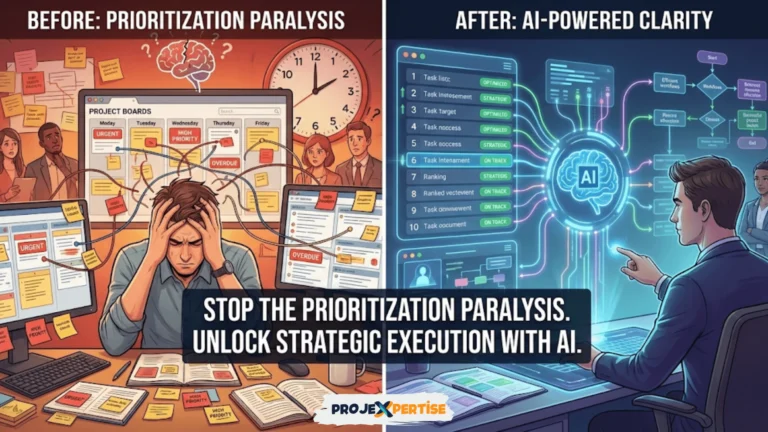
Three specific obstacles derail most adoption attempts. First, information overload creates decision paralysis. Hundreds of AI tools claim to revolutionize project management. Without evaluation frameworks, choosing becomes overwhelming, so project managers defer decisions indefinitely.
Second, implementation knowledge gaps create false starts. Tools require initial configuration, team training, and workflow adjustment. Most project managers lack clear guidance on sequencing these activities, so they attempt everything simultaneously and get overwhelmed.
Third, measurement uncertainty prevents persistence. Without clear metrics for success, project managers cannot determine whether AI implementations are working. Ambiguous results make it easy to abandon approaches prematurely when obstacles arise.
Successful AI adoption requires addressing all three obstacles systematically. Clear tool selection criteria, step-by-step implementation guidance, and specific success metrics. This is precisely what AI Empowerment for Project Managers provides through its structured 30-day transformation roadmap.
The 30-Day AI Transformation Framework
Sustainable AI adoption follows a specific pattern across successful implementations. It starts with high-impact, low-complexity use cases that build confidence and demonstrate value quickly. Success in foundational areas creates momentum for more ambitious deployments. Within 30 days, AI becomes integrated seamlessly into daily workflows.
The framework is divided into four distinct phases, each with specific objectives and measurable outcomes. First week establishes foundations. The second week implements core productivity tools. The Third Week adds advanced capabilities. And the fourth week optimizes and scales successful implementations.
This structured approach prevents overwhelm while ensuring consistent progress. Each week builds on previous successes rather than introducing completely new concepts. The learning curve remains manageable even for project managers with limited technical backgrounds.
Week 1: Foundation and Quick Wins
The first week focuses on immediate productivity gains through simple AI applications. Meeting documentation automation provides the ideal starting point because results appear immediately, setup complexity is minimal, and time savings are obvious to everyone.
AI meeting assistants transcribe conversations in real time, identify action items automatically, and generate distributable summaries without manual effort. What previously required 30 minutes of post-meeting work now happens automatically during the meeting itself. You review AI-generated summaries, make minor adjustments, and distribute to stakeholders in under five minutes.
The transformation extends beyond time savings. Automated documentation is more comprehensive than manual notes. Nothing gets forgotten or misinterpreted. Action items include exact wording and context. Follow-up becomes systematic rather than relying on memory or incomplete notes.
Week one also introduces AI-powered task prioritization. Project management tools with AI capabilities analyze your project plan, current progress, resource availability, and deadlines to recommend optimal task sequencing. This eliminates the daily cognitive burden of deciding what matters most.
By week one’s end, project managers typically reclaim 3-4 hours weekly through meeting automation and improved prioritization alone. More importantly, they build confidence that AI implementation is practical rather than theoretical. This confidence fuels continued adoption through more challenging implementations.
Week 2: Automated Reporting and Analysis
Week two tackles one of project management’s most time-intensive activities: status reporting. Traditional reporting requires gathering data from multiple systems, synthesizing information, formatting consistently, and distributing it to various stakeholders. The process repeats weekly or daily, consuming 2-3 hours each cycle.
AI report generators connect to your project management software, pull data automatically, and produce formatted reports on schedule. Initial setup requires defining data sources, report templates, and distribution lists. But once configured, the system runs indefinitely with minimal intervention.
Advanced implementations add analytical capabilities. The AI identifies trends across reporting periods, flags anomalies worth investigating, and suggests narrative explanations for significant variances. Your role shifts from data compilation to strategic interpretation and decision making.
Week two also introduces automated risk assessment capabilities. AI tools analyze historical project data to identify patterns invisible to human observers. They flag emerging risks before they become critical, suggest mitigation strategies based on similar scenarios, and estimate the probability of specific outcomes.
This doesn’t eliminate human judgment. AI identifies risks humans might miss, but experienced project managers still make final decisions about response strategies. The combination of machine pattern recognition and human intuition produces superior outcomes while consuming far less time.
By combining automated reporting with continuous risk assessment, week two typically saves an additional 4-5 hours weekly while improving both report quality and risk management effectiveness.
Week 3: Advanced Communication and Decision Support
Week three addresses stakeholder communication, one of project management’s most critical yet time-intensive responsibilities. Different stakeholders need different information. Executives want high-level summaries focused on business impact. Technical teams need detailed specifications. Clients care about deliverables and timelines.
Crafting personalized communications for each audience traditionally consumes significant time. AI solves this through intelligent content adaptation. You create one comprehensive project update. The AI generates customized versions for different stakeholder groups, adjusting the detail level, technical depth, and focus areas based on recipient profiles.
Advanced systems analyze stakeholder engagement patterns to optimize communication timing, format, and frequency. The AI learns which stakeholders prefer detailed written updates versus brief verbal summaries and adjusts delivery accordingly. This creates better outcomes while reducing your time investment by 50-60%.
Week three also implements AI-powered decision support systems. Project managers make hundreds of decisions weekly about resource allocation, schedule adjustments, vendor selections, and scope changes. Each decision requires gathering information, evaluating options, and predicting outcomes.
AI serves as a decision support system that compresses analysis time dramatically. Present the system with a decision context, available options, and relevant constraints. It analyzes historical data, identifies patterns from similar situations, and presents recommendations with supporting rationale.
Effective decision-making frameworks combined with AI support create significant competitive advantages. You make decisions in minutes rather than hours, with greater confidence because analysis considers factors human cognition might overlook.
Week 4: Optimization and Scaling
The final week focuses on optimizing successful implementations and scaling AI adoption across your project portfolio. You identify which tools deliver the most value, refine their configurations, and eliminate any that don’t justify their complexity.
Week four also addresses team adoption. While weeks one through three focus on your personal productivity transformation, lasting change requires team engagement. The complete implementation guide provides specific strategies for introducing AI tools to team members without creating resistance or overwhelming them.
This includes change management techniques tailored for AI adoption, training approaches that work for diverse skill levels, and methods for demonstrating value that build enthusiasm rather than anxiety. Successful team adoption multiplies your personal productivity gains across the entire project organization.
By the end of 30 days, AI tools are integrated seamlessly into your daily workflows. They run automatically in the background, freeing your attention for strategic thinking and relationship building. The transformation is complete when you cannot imagine working without these capabilities.
The Five Core AI Capabilities Every Project Manager Needs
Across hundreds of successful implementations, five AI capabilities consistently deliver the highest return on investment for project managers. These form the core of any effective AI productivity transformation.
1. Intelligent Meeting Management
Meeting overhead represents one of project management’s biggest productivity drains. The average project manager spends 23 hours weekly in meetings. While meetings themselves provide value, the administrative overhead surrounding them does not.
AI meeting assistants handle this overhead automatically. They join meetings, transcribe conversations in real time, identify speakers, and generate searchable transcripts. More importantly, they parse conversations for commitments, deadlines, decisions, and action items without requiring manual note-taking.
The productivity gain is substantial. You participate fully in meetings rather than dividing attention between discussion and documentation. Post-meeting work drops from 30 minutes to under 5 minutes for final review and distribution. Your weekly meeting administration time falls from 5 hours to under 30 minutes.
Modern meeting AI goes beyond basic transcription. It identifies topics discussed, tracks how much time each topic consumed, flags when conversations drift off-topic, and even detects emotional tone in discussions. This metadata helps you run more effective meetings by identifying patterns in how time gets used.
2. Automated Project Reporting
Status reporting is essential but tedious. You gather data from multiple project management tools, synthesize information, format everything consistently, and distribute reports to various stakeholders. The same process repeats weekly or daily.
AI report generators transform this entirely. Connect them to your data sources, and they pull information automatically. Schedule completion rates, budget variance, risk status, and milestone progress all aggregate into formatted reports matching your preferred style.
The initial setup requires investment. You define data sources, report templates, distribution lists, and scheduling parameters. But once configured, the system runs indefinitely. Your weekly reporting time drops from 3 hours to 15-20 minutes for review and adjustment.
Advanced implementations add predictive analytics. The AI doesn’t just report the current status. It forecasts likely outcomes based on current trends, identifies leading indicators of problems, and suggests proactive interventions before issues become critical.
3. Continuous Risk Intelligence
Traditional risk management happens quarterly if you’re diligent. You identify risks, assess probability and impact, plan mitigation strategies, and monitor progress. Then you wait three months before the next formal assessment.
This periodic approach misses risks that emerge between assessments. By the time they appear in formal reviews, they may already be causing problems. AI risk tools provide continuous monitoring instead.
They analyze hundreds of variables across schedule, resources, dependencies, and external factors. Each day, they identify new risks and update assessments for existing ones based on project developments. You review what the system flagged rather than trying to imagine everything that could go wrong.
The AI doesn’t just identify risks. It quantifies probability and impact based on patterns from thousands of similar projects. A scope change that seems minor might carry hidden complexity based on similar past experiences. This data-driven assessment prevents the optimism bias that causes project managers to underestimate risks.
4. AI-Powered Decision Support
Project managers make hundreds of decisions weekly. Resource allocation, schedule adjustments, vendor selections, and scope changes. Each requires gathering information, evaluating options, and predicting outcomes. The cognitive load is exhausting.
AI decision support systems compress analysis time dramatically. They process variables instantly, model different scenarios, quantify trade-offs, and present options ranked by likely success. You make decisions in minutes rather than hours, with greater confidence because the analysis is more comprehensive.
Consider resource allocation decisions. You need three developers for a critical feature, but only two are available. Traditional analysis involves reviewing project priorities, assessing skill requirements, evaluating training needs, and estimating schedule impacts.
AI tools process these variables instantly. They model different scenarios, quantify trade-offs, and present options ranked by likely success. The key is understanding AI’s role. It doesn’t make decisions for you. It accelerates the analytical phase so you can focus cognitive energy on judgment and strategic thinking.
5. Personalized Stakeholder Communication
Stakeholder communication makes or breaks projects. But preparation is time-intensive. You need to understand each stakeholder’s concerns, recent developments they care about, and the context from past interactions.
AI stakeholder management tools track every interaction, identify patterns in concerns and preferences, and surface relevant project developments automatically. Each morning, you review which stakeholders you’ll likely interact with and what they probably care about.
The system analyzes communication sentiment, identifies stakeholders showing early signs of concern, and flags relationships requiring attention before they deteriorate. This early warning prevents the relationship crises that derail projects.
Your stakeholder communication time drops dramatically while satisfaction actually increases because each recipient gets information tailored to their specific needs and preferences.
Measuring Your AI Productivity Transformation
Effective AI implementation requires clear success metrics. Without measurement, you cannot determine whether investments are paying off or which tools deserve continued attention versus elimination.
The framework includes three categories of metrics: time savings, quality improvements, and outcome enhancements. Together, they provide comprehensive visibility into AI’s impact on your productivity and project success.
Time Savings Metrics
Time savings represent the most immediate and obvious benefit of AI adoption. Track weekly hours spent on specific activities before and after AI implementation. Focus on these high-impact categories:
Meeting documentation and follow-up typically drops from 5 hours weekly to under 30 minutes. Status report creation falls from 3 hours to 15-20 minutes. Risk assessment time decreases from monthly 2-hour sessions to daily 5-minute reviews. Stakeholder communication preparation is reduced by 50-60%.
Aggregate these individual savings, and most project managers reclaim 10-15 hours weekly. But time savings alone don’t capture AI’s full value. Quality improvements and outcome enhancements often matter more.
Quality Improvement Metrics
AI doesn’t just save time. It improves output quality in measurable ways. Meeting documentation becomes more comprehensive because nothing gets forgotten or misinterpreted. Reports include more sophisticated analysis because AI processes data that humans would miss.
Risk assessments identify more potential issues earlier in project lifecycles. Decision quality improves because the analysis considers more variables and historical patterns. Stakeholder communications become more targeted and effective.
Track metrics like risk identification rate, decision reversal frequency, stakeholder satisfaction scores, and report comprehensiveness ratings. These quality indicators often predict project success better than time savings alone.
Outcome Enhancement Metrics
The ultimate test of AI adoption is project outcome improvement. Do projects using AI tools finish on time more often? Stay within budget more consistently? Meet quality standards more reliably? Generate higher stakeholder satisfaction?
Track traditional project success metrics across AI-enabled projects versus those using traditional approaches. Control for project complexity, team experience, and other variables that influence outcomes independent of tools.
Project managers implementing AI systematically typically see 15-20% improvement in schedule adherence, 10-15% reduction in budget variance, and measurably higher stakeholder satisfaction scores. These outcome improvements justify AI investments even without considering time savings.
Common Implementation Challenges and Solutions
Even with systematic frameworks, AI adoption presents challenges. Understanding common obstacles and their solutions prevents frustration and ensures persistence through difficult phases.
Challenge 1: Tool Selection Paralysis
Hundreds of AI tools claim to revolutionize project management. Evaluating options consumes significant time, and choosing wrong creates expensive mistakes. This analysis paralysis causes many project managers to defer adoption indefinitely.
The solution is a structured evaluation framework focusing on four criteria: integration capability with existing systems, learning curve for you and your team, pricing sustainability as usage scales, and vendor stability for long-term reliability.
Start with tools that integrate seamlessly with your current project management software. This minimizes disruption and ensures data flows automatically. Prioritize tools with free trials so you can test thoroughly before committing financially.
The comprehensive AI implementation roadmap includes specific tool recommendations across all major categories, complete with evaluation criteria and implementation guidance. This eliminates analysis paralysis by providing proven options rather than requiring exhaustive research.
Challenge 2: Team Resistance and Adoption
Individual productivity gains mean little if your team resists AI tools or uses them inconsistently. Team adoption requires addressing legitimate concerns about job security, learning curves, and disruption to established workflows.
The solution starts with transparency about AI’s role. It doesn’t replace team members. It eliminates tedious work so they can focus on interesting challenges requiring human creativity and judgment. Frame AI as a tool that makes everyone’s job better, not one that makes jobs unnecessary.
Introduce tools gradually rather than deploying everything simultaneously. Start with capabilities that solve obvious pain points and demonstrate value quickly. Success builds enthusiasm that carries through more complex implementations.
Provide comprehensive training tailored to different skill levels. Some team members embrace technology eagerly, while others need more support. Accommodate both groups without slowing adoption for the enthusiastic while abandoning those who need guidance.
Challenge 3: Integration with Existing Systems
Most project managers use established tools for task management, communication, documentation, and reporting. AI tools add value only if they integrate seamlessly rather than creating another system requiring manual data transfer.
Prioritize AI capabilities offered within tools you already use. Many modern project management platforms now include AI features. These integrated capabilities work better than standalone tools because data flows automatically without integration effort.
When standalone AI tools are necessary, evaluate integration options carefully. Look for direct connections via APIs, support for common file formats, or integration platforms like Zapier that bridge different systems. Avoid tools requiring manual data export and import for every use.
The implementation challenge isn’t just technical. It’s also about workflow redesign. AI tools work best when processes are redesigned around their capabilities rather than simply automating existing manual workflows. The 30-day transformation guide addresses both technical integration and workflow optimization systematically.
Challenge 4: Measuring ROI Effectively
Many project managers struggle to quantify AI’s return on investment. Time savings seem obvious but are difficult to track precisely. Quality improvements resist simple measurement. Outcome enhancements take months to become statistically significant.
The solution is a staged measurement approach. Start with simple time tracking for specific activities like meeting documentation and status reporting. Use actual clock time rather than estimates to ensure accuracy. This provides immediate, indisputable evidence of productivity gains.
Add quality metrics as implementations mature. Track completeness of meeting documentation, comprehensiveness of risk assessments, and accuracy of predictive analytics. Compare outputs before and after AI adoption to quantify improvements.
Finally, measure project outcomes across multiple projects to identify patterns. Individual project success depends on many variables beyond tools. But across dozens of projects, AI’s impact on outcomes becomes statistically clear.
Advanced AI Capabilities for Mature Implementations
Once core capabilities are running smoothly, advanced AI applications unlock even greater productivity gains. These sophisticated implementations require solid foundations but deliver transformational results for project managers ready to push beyond basics.
Predictive Project Analytics
Basic AI tools report the current project status. Advanced implementations predict future outcomes based on current trends, historical patterns, and external factors. This predictive capability transforms project management from reactive to proactive.
Predictive analytics identifies problems weeks before they become critical. Schedule trends suggesting likely delays, budget patterns indicating overruns, and resource utilization rates forecasting bottlenecks all surface early enough for prevention rather than remediation.
The system doesn’t just predict problems. It recommends interventions based on what worked in similar situations historically. When schedule pressure increases, it suggests specific strategies that successfully addressed similar challenges in past projects.
Automated Workflow Orchestration
Individual AI tools provide point solutions for specific tasks. Workflow orchestration connects multiple tools into automated sequences that handle entire processes without manual intervention.
Consider the weekly status update process. Orchestration connects data collection, analysis, report generation, personalization for different stakeholders, distribution, and follow-up tracking into a single automated workflow. You review final outputs rather than managing each step manually.
Orchestration requires mature tool adoption and solid technical foundations. But it represents the ultimate productivity multiplier because it eliminates entire categories of work rather than just speeding individual tasks.
Natural Language Project Management
Emerging AI capabilities allow project management through natural language conversation rather than traditional interfaces. You ask questions or give instructions in plain English, and AI interprets intent and executes appropriate actions.
“Show me all risks rated high probability that haven’t been reviewed in the past two weeks.” The AI queries your risk database, filters appropriately, and presents results in whatever format you prefer.
“Generate a status report for executives focusing on budget variance and schedule adherence.” The system pulls data, formats it for executive consumption, and creates the report without requiring you to navigate multiple interfaces or configure report parameters manually.
Natural language interfaces reduce cognitive load dramatically because you think about what you want rather than how to make systems do it. This capability is still emerging, but it will become standard as AI language models improve.
Building Your Personal AI Transformation Roadmap
Generic AI adoption guidance fails because every project manager’s context differs. Your organization’s tools, team dynamics, project types, and personal work style all influence which approaches work best.
The most effective AI transformations follow personalized roadmaps adapted to individual circumstances while maintaining proven structural frameworks. This section guides you through creating your personal 30-day implementation plan.
Week 1: Assessment and Foundation
Begin by auditing your current productivity baseline. Track actual time spent on major activities for one complete week. Meeting attendance and documentation, status reporting, risk management, stakeholder communication, team coordination, strategic planning, and administrative overhead.
This baseline data serves two purposes. First, it identifies which activities consume disproportionate time relative to the value produced. These become priority targets for AI implementation. Second, it provides measurement benchmarks for quantifying improvements as you implement AI capabilities.
Simultaneously, audit your current tool stack. What project management software do you use? What communication platforms? And what documentation systems? Understanding your existing ecosystem helps identify AI tools that integrate seamlessly versus those requiring complex workarounds.
Finally, identify your biggest productivity pain points. What activities frustrate you most? What tasks do you frequently postpone because they’re tedious? And what processes do team members complain about? Pain points make ideal starting points because motivation remains high even when implementation challenges arise.
Week 2-3: Core Capability Implementation
Select 2-3 AI capabilities that address your highest-priority pain points while offering straightforward implementation. Meeting automation and automated reporting typically work well because they solve obvious problems, integrate with existing tools relatively easily, and demonstrate value immediately.
Implement these foundational capabilities following proven patterns. Start with tool selection using evaluation criteria that emphasize integration capability and ease of use. Configure tools thoroughly during initial setup rather than rushing to production use. Test extensively with low-stakes activities before deploying for critical work.
Document your implementation process as you proceed. What worked well? What obstacles did you encounter? How did you resolve problems? This documentation helps team members when you scale adoption and provides material for continuous improvement.
Measure results rigorously from day one. Track time spent on target activities before and after AI implementation. Document quality improvements you notice. Note any unexpected benefits or challenges that emerge.
Week 4: Optimization and Expansion
The final week focuses on refinement and planning for continued expansion. Review your initial implementations critically. What’s working well? What needs adjustment? What unexpected issues arose?
Optimize configurations based on actual use rather than initial assumptions. You may discover that certain report formats work better than others, or that meeting documentation needs different levels of detail for different meeting types. Adjust tools to match real requirements rather than forcing workflows to match tool defaults.
Begin planning your next wave of AI adoption. With foundational capabilities running smoothly, you’re ready for more sophisticated implementations. Advanced risk management tools, AI-powered decision support systems, and automated stakeholder communication platforms become viable.
Most importantly, start sharing your experience with team members. Demonstrate time savings and quality improvements you’ve achieved. Offer to help interested team members implement similar capabilities. Organic team adoption driven by demonstrated value works far better than top-down mandates.
The Competitive Advantage of AI-Powered Project Management
Project management is becoming increasingly competitive. Organizations recognize that project success directly influences business outcomes, so they invest in skilled project managers. The best opportunities flow to those with proven track records of delivering results consistently.
AI creates a widening gap between early adopters and traditional practitioners. Project managers leveraging AI systematically deliver better results with less stress and time investment. They spot risks earlier, make better decisions, maintain stronger stakeholder relationships, and complete projects more successfully.
This advantage compounds over time. Every project strengthens your AI-assisted approach. Pattern recognition improves. Tool configurations are optimized. The gap between AI-enabled project managers and traditional practitioners widens continuously.
The barrier to entry is remarkably low. Basic AI tools are free or inexpensive. Implementation doesn’t require technical expertise or programming skills. The learning curve is manageable for any professional willing to invest focused effort. Yet most project managers will read about these capabilities, acknowledge their value, and never actually implement them.
This creates an extraordinary opportunity for action takers. While competitors hesitate, you build advantages that become increasingly difficult to replicate. Within six months, your AI-assisted approach produces results that would take traditional practitioners years to match.
The complete AI transformation framework provides everything needed to capture this competitive advantage. Structured implementation guidance, proven tool recommendations, troubleshooting resources, and success metrics. Everything distilled from hundreds of successful AI adoptions into a single systematic roadmap.
Your First Steps Toward AI-Powered Productivity
Reading about AI productivity gains is interesting. Experiencing them transforms your career. The distance between these states is smaller than most project managers imagine, but it requires taking specific action rather than waiting for perfect conditions.
Your first step happens today. Audit your current time allocation for one week. Track hours spent on major activities. Identify your biggest productivity pain points. Research AI tools that address those specific challenges. This assessment phase requires no financial investment and minimal time commitment, but it provides the foundation for everything that follows.
Next week, select one AI capability and implement it fully. Meeting automation makes an excellent starting point because setup is straightforward, results appear immediately, and time savings are obvious. Alternatively, choose automated reporting if that represents a bigger pain point for you. The specific tool matters less than committing to full implementation rather than superficial experimentation.
Measure results rigorously from day one. Track time savings, note quality improvements, and document any obstacles encountered. This data justifies continued investment and provides motivation when inevitable challenges arise during implementation.
Within 30 days, you’ll have multiple AI capabilities running smoothly. Administrative overhead will have dropped dramatically. Strategic thinking time will have increased substantially. Project outcomes will have improved measurably. You’ll wonder how you ever managed projects without these capabilities.
The complete 30-day AI transformation roadmap provides detailed guidance for every step of this journey. Day-by-day implementation plans, specific tool recommendations, troubleshooting guides for common challenges, and frameworks for measuring success. Everything needed to transform AI from an intimidating concept into your most powerful productivity multiplier.
The project management profession is evolving rapidly. AI capabilities expand continuously. The project managers mastering these tools today will lead the profession tomorrow. Those waiting for perfect conditions or more certainty will find themselves struggling to catch up as the competitive gap widens.
Your productivity transformation begins with a single decision followed by focused action. Start your assessment today. Implement your first AI capability next week. Within 30 days, you’ll have captured competitive advantages that compound throughout your career.
The future of project management is AI-augmented, and that future arrives faster than most professionals realize. Position yourself among the leaders rather than the followers. Your projects, your career, and your work-life balance will all benefit from making that choice today.